
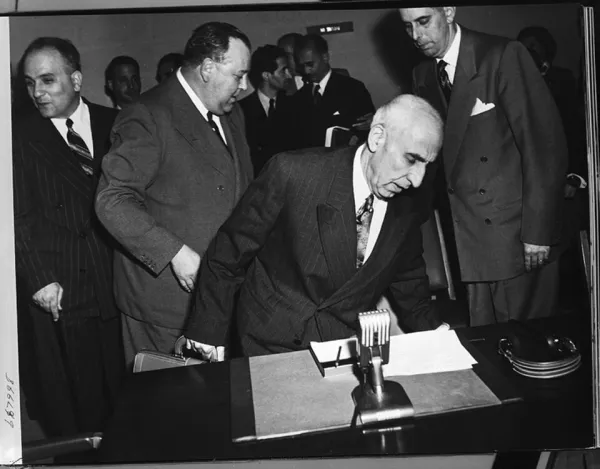
Prime Minister Mohammad Mossadegh of Iran taking seat at the United Nations Security Council.jpg Harry S. Truman Presidential Library and Museum, Public domain, via Wikimedia Commons

The overthrow of Mohammad Mossadegh on August 19, 1953, stands as one of the most consequential coups of the twentieth century, marking a decisive moment in the consolidation of modern imperialist intervention. Operation Ajax was not merely the removal of a democratically legitimate, anti-imperialist government; it represented a deliberate effort by the United States and Britain to discipline a postcolonial state that sought control over its own resources. In doing so, it established a durable template for undermining nationalist movements that threatened Western imperial strategic and corporate dominance.
In the aftermath of Mossadegh’s overthrow, Iran’s experiment with oil nationalization was swiftly dismantled. Control over the country’s petroleum sector was reorganized through an international consortium that overwhelmingly favored Western capital: 40 percent was allocated to five U.S. companies, another 40 percent to British Petroleum, 14 percent to Royal Dutch Shell, and 6 percent to the French Compagnie Française des Pétroles. This redistribution effectively reinserted Iran’s most vital resource into a Western-dominated system of accumulation, subordinating national sovereignty to external economic control.
This arrangement ensured not only continued Western access to Iran’s oil wealth but also entrenched the Shah’s dependence on U.S. and British support. Backed by foreign capital and security assistance, Mohammad Reza Shah Pahlavi consolidated an authoritarian regime that relied on repression to maintain stability. In the years that followed, more than 10,000 U.S. advisers operated within Iran, integrating the country into a broader architecture of Western geopolitical power in the Middle East. The Shah’s rule ultimately collapsed under the weight of popular opposition during the Iranian Revolution, which led to the establishment of the Islamic Republic of Iran—a transformation that itself reflected the long-term consequences of externally imposed political and economic domination.
Half a century later, the Iraq War followed a different modality but revealed a similar structural logic. The United States invaded Iraq on March 20, 2003, under the pretext that Iraq possessed weapons of mass destruction (WMDs) and maintained ties to terrorism—claims that were subsequently discredited. Rather than a defensive necessity, the invasion has been widely interpreted as an act of imperial projection aimed at restructuring Iraq’s political economy in line with U.S. strategic and corporate interests. The war evolved into a protracted occupation lasting over eight years, formally ending with the U.S. military withdrawal on December 18, 2011.
Yet the end of direct military occupation did not signify the end of U.S. dominance. Washington continued to exert decisive influence over Iraq’s political institutions, security apparatus, and economic structures. Central to this system of control was the channeling of Iraqi oil revenues into an account at the Federal Reserve Bank of New York, effectively placing a key pillar of Iraq’s national wealth under U.S. oversight. In this configuration, sovereignty is not eliminated but reconstituted as a conditional form: Iraq retains formal independence while its fiscal autonomy is structurally constrained by external oversight and geopolitical leverage.
This logic is further illustrated by more recent developments. The United States has reportedly halted or restricted the transfer of U.S. dollars to Iraq, intensifying financial pressure on Baghdad to limit the influence of Iran-aligned political and armed groups. Such measures underscore how monetary flows themselves function as instruments of political discipline, where access to liquidity becomes a lever for shaping domestic power relations. Rather than operating as a post-occupation withdrawal, U.S. engagement thus persists through the governance of economic circulation, reinforcing a system in which sovereignty is continuously mediated through external financial control.
A similar pattern is visible in the January 3, 2026, intervention in Venezuela. The United States launched a large-scale military strike, capturing President Nicolás Maduro and Cilia Flores in what was widely understood as a unilateral act of regime change. The administration of Donald Trump justified the operation as a law-enforcement action against “narco-terrorism,” yet the subsequent reorganization of political and economic power suggests broader objectives. With U.S. backing, Vice President Delcy Rodríguez was installed as acting president, while sanctions on Venezuelan oil were selectively lifted—facilitating reintegration into global markets under U.S. oversight.
Crucially, this reintegration did not restore economic sovereignty. Instead, oil revenues were routed through externally controlled financial mechanisms, effectively placing Venezuela’s primary source of wealth under foreign supervision. In this arrangement, the state is permitted to generate revenue but not to exercise autonomous control over it. Economic exchange thus becomes a mechanism of political discipline, constraining the range of domestic policies while embedding the country within a U.S.-aligned economic order. The rhetoric of stability and reconstruction stands in tension with a reality in which sovereignty is mediated through external authority.
The United States and Israel launched another major intervention on February 28, 2026, in a coordinated campaign against Iran. Targeting military and civilian infrastructure, nuclear facilities, and political leadership, the initial strikes killed Ali Khamenei and caused widespread destruction. A ceasefire was reached on April 8, 2026, yet the scale of the offensive failed to produce decisive regime collapse or political capitulation.
What has emerged instead is a protracted struggle over the terms of regional order. Repeated negotiations have stalled, and the conflict has shifted from direct military confrontation to a broader strategy combining sanctions, blockade, and geopolitical isolation. This trajectory underscores a key transformation in the modality of intervention: when rapid military victory proves unattainable, control is pursued through longer-term mechanisms that target the economic and institutional foundations of sovereignty.
Taken together, these cases suggest that U.S.-led interventions follow a recurring pattern. Military or covert operations initiate a process of disruption, but the ultimate objective lies in the reorganization of political authority and economic flows. Control over strategic resources—especially oil—remains central, yet it is increasingly exercised through indirect means: financial systems, sanctions regimes, and externally mediated access to national revenue. Sovereignty, in this context, is not simply violated; it is restructured into a conditional form, in which states retain formal independence but operate within constraints imposed by external power.
At the same time, these interventions reveal persistent contradictions. The 1953 coup in Iran contributed to the revolutionary upheaval of 1979, demonstrating how externally imposed stability can generate long-term instability. Similarly, the ongoing tensions surrounding Iran and the fragility of post-invasion Iraq highlight the limits of external control. Military dominance does not easily translate into durable political legitimacy, and efforts to discipline states often produce resistance that undermines the very order they seek to establish.
This analysis supports a broader hypothesis: modern imperial intervention operates not primarily through territorial conquest, but through the production of “managed sovereignty.” States are not simply occupied; they are integrated into a hierarchical global system in which their political and economic autonomy is systematically constrained. What is presented as security, stabilization, or development thus functions, in practice, as the maintenance of an unequal distribution of power.
In conclusion, modern U.S.-led interventions—from Iran in 1953 through Iraq in 2003, Venezuela in 2026, and the current war with Iran—should not be read as episodic reactions to security threats, but as articulations of a continuous imperial formation that has evolved in form while retaining its structural logic. What appears historically as discrete moments of intervention is better understood as the operational rhythm of a global system of power concerned less with territorial occupation than with the production and regulation of peripheral statehood.
Across these cases, the modality of domination has shifted from overt coercion—coups, invasions, and military occupations—to more diffuse and resilient techniques of governance: sanctions regimes, financial infrastructures, debt architectures, and the strategic modulation of market access. Yet this transformation does not signal a decline of imperial power; rather, it marks its deepening abstraction. Coercion is no longer primarily exercised through direct control of territory, but through the command of the conditions of circulation—capital, energy, and credit—through which sovereign decision-making becomes structurally dependent.
What is revealed, then, is not a world of sovereign equality punctuated by intervention, but a hierarchical system in which sovereignty itself is differentially produced and allocated. States are not simply violated from without; they are constituted through relations of dependency that define the very limits of their autonomy. Intervention functions as a mechanism of reconfiguration: it dismantles autonomous political projects and re-inscribes them within circuits of external regulation, producing what may be understood as a condition of structurally administered sovereignty.
From this perspective, the language of security, stabilization, and reconstruction operates as a legitimating ideology for a deeper process: the ongoing reorganization of global political economy in accordance with the strategic imperatives of dominant imperial powers. The enduring function of intervention is therefore not the resolution of disorder, but the continuous production of a governable world—one in which sovereignty exists only insofar as it is compatible with the asymmetries of imperial capital and power.
Read through this lens, the posture of the Trump administration toward Iran—defined by maximalist demands, sustained economic warfare, and perpetually deferred diplomacy—appears less as a response to discrete security threats than as a strategy of coercive realignment. Negotiation, in this context, functions not as a genuine avenue for compromise but as an instrument of compulsion, calibrated to force Tehran’s incorporation into a hierarchically ordered system it has thus far refused to accept. The persistence of stalemate reveals the limits of coercion when confronted with a regime unwilling to subordinate its sovereignty to external imperatives.